

Morning workouts have a branding problem.
They’re often presented as a test of character: wake up at 4:45, drink something that tastes like ambition, run sprints in the dark, and emerge as a superior human being. If you can’t do that, the story goes, you must not want it badly enough.
But most people who exercise in the morning aren’t chasing sainthood. They’re chasing practicality. They’re trying to fit movement into a life that fills up quickly—with work, family, commutes, the unpredictable weather of other people’s schedules. Morning is not always ideal. It’s simply available.
The mistake is treating morning training like it must be intense to “count.” For many bodies, morning arrives with stiffness, low body temperature, and a nervous system still negotiating with the day. A workout that punishes you for this—too hard, too sudden, too much—doesn’t build consistency. It builds dread.
A good morning workout is not a performance. It’s a transition. It should leave you more awake, more capable, and, if possible, slightly proud—not flattened, nauseated, or resentful.
Below are five morning workouts designed for real mornings: the kind where you have limited time, inconsistent energy, and a human body that does not instantly behave like a machine. Each workout can be done in 10 to 30 minutes. None requires you to hate yourself to get results.
Before we start, a few quiet rules that make morning training kinder—and better.
The three rules of morning workouts that actually last
1) Start smaller than you think you should
Morning workouts fail when they begin like a dare. Your joints and tissues need a ramp. Your nervous system needs a signal that you’re safe. The first three minutes should be “easy enough to continue.”
2) Choose a workout that matches your morning, not your fantasy self
Some mornings you’re ready for intensity. Many mornings you’re not. The best plan includes options: a strength day, a gentle conditioning day, a mobility day. You don’t build consistency by repeating heroics; you build it by showing up in a way you can repeat.
3) Use the “wake-up tax” wisely
In the morning you pay a tax: stiffness, grogginess, maybe poor sleep. Don’t spend that tax on complicated programming. Spend it on basics that work: push, pull, squat, hinge, carry, walk. Simple movements, done with care, get you most of what you want.
Now, the workouts.
Workout 1: The 12-Minute “Wake Up, Not Wrecked” Circuit
Best for: most days, especially when you feel stiff or low-energy
Time: 12 minutes
Equipment: none (optional light dumbbells)
This is the workout you do when you want to be proud you moved, but you don’t want to fight your body. It’s enough to raise your heart rate, wake your joints, and give you that “I did something” feeling—without requiring a debate with your willpower.
Warm-up (2 minutes)
- 30 seconds marching in place
- 30 seconds arm circles + shoulder rolls
- 30 seconds hip hinges (hands on hips, push hips back)
- 30 seconds gentle squats
Main circuit (10 minutes)
Set a timer for 10 minutes. Move through these exercises at a steady pace. Rest when needed.
- Bodyweight Squat — 8–12 reps
- Incline Push-Up (hands on a counter or couch) — 6–12 reps
- Glute Bridge — 10–15 reps
- Dead Bug — 6 reps per side
- Brisk March or Step-Ups — 30–45 seconds
Repeat until time is up.
How it should feel: like you’re waking up. Your breathing should be elevated, but you should still be able to speak in short sentences. If you’re gasping, slow down. If it feels too easy, add a round next time or hold light dumbbells for the squats.
Why it works: It trains major patterns gently, strengthens the core without crunches, and prepares you for the day’s real movements: sitting, lifting, climbing stairs, carrying bags.
Workout 2: The “Coffee Isn’t Ready Yet” Strength Session
Best for: building muscle and strength without needing a gym
Time: 20–25 minutes
Equipment: one or two dumbbells (or a backpack with books)
This is a morning strength workout for people who want results—without turning training into punishment. It doesn’t chase exhaustion. It chases competence.
Warm-up (3 minutes)
- 10 hip hinges
- 10 squats
- 6 push-ups (incline if needed)
- 10 shoulder blade squeezes (standing “row” motion)
Strength block (18–20 minutes)
Do 3 rounds. Rest 45–75 seconds between exercises.
- Goblet Squat (or backpack front squat) — 8–12 reps
- Romanian Deadlift (dumbbells or backpack) — 8–12 reps
- One-Arm Row — 10 reps per side
- Dumbbell Floor Press (or incline push-ups) — 8–12 reps
- Suitcase Carry (one dumbbell) — 30–45 seconds per side
If you only have bodyweight: swap rows for towel rows (wrap a towel around a sturdy post and lean back) or do prone “Y-T” raises.
Why it works: It hits legs, glutes, back, chest, and core in a balanced way. It builds strength without requiring a loud nervous system. And it doesn’t leave you wrecked before your day begins.
Progression: Add one rep per set each week until you hit the top of the range; then increase weight slightly.
Workout 3: The 15-Minute Low-Impact Cardio That Doesn’t Feel Like a Punishment
Best for: fat loss, heart health, stress relief, “I need to move but I’m tired” mornings
Time: 15 minutes
Equipment: none (optional treadmill or bike)
Not every morning wants burpees. Many mornings want a gentle, steady push—a workout that elevates your heart rate without spiking your nervous system.
This is “cardio without drama.”
Option A: Outdoor walk (the simplest version)
- 2 minutes easy
- 10 minutes brisk (you should breathe harder but still talk)
- 3 minutes easy
Option B: At-home low-impact intervals
Set a timer for 15 minutes. Alternate:
- 1 minute brisk marching in place (swing arms, knees up)
- 1 minute easy movement (slow march, light steps, breathe)
If you want more intensity without impact, add:
- shadow boxing during the brisk minutes
- step-ups on a sturdy stair
- fast wall sits (20 seconds) followed by easy marching
Why it works: It’s sustainable. It reduces stress. It builds aerobic capacity. And importantly, it doesn’t leave you sweaty and depleted in a way that makes the shower feel like another chore.
A morning workout that feels manageable is a morning workout you do again.
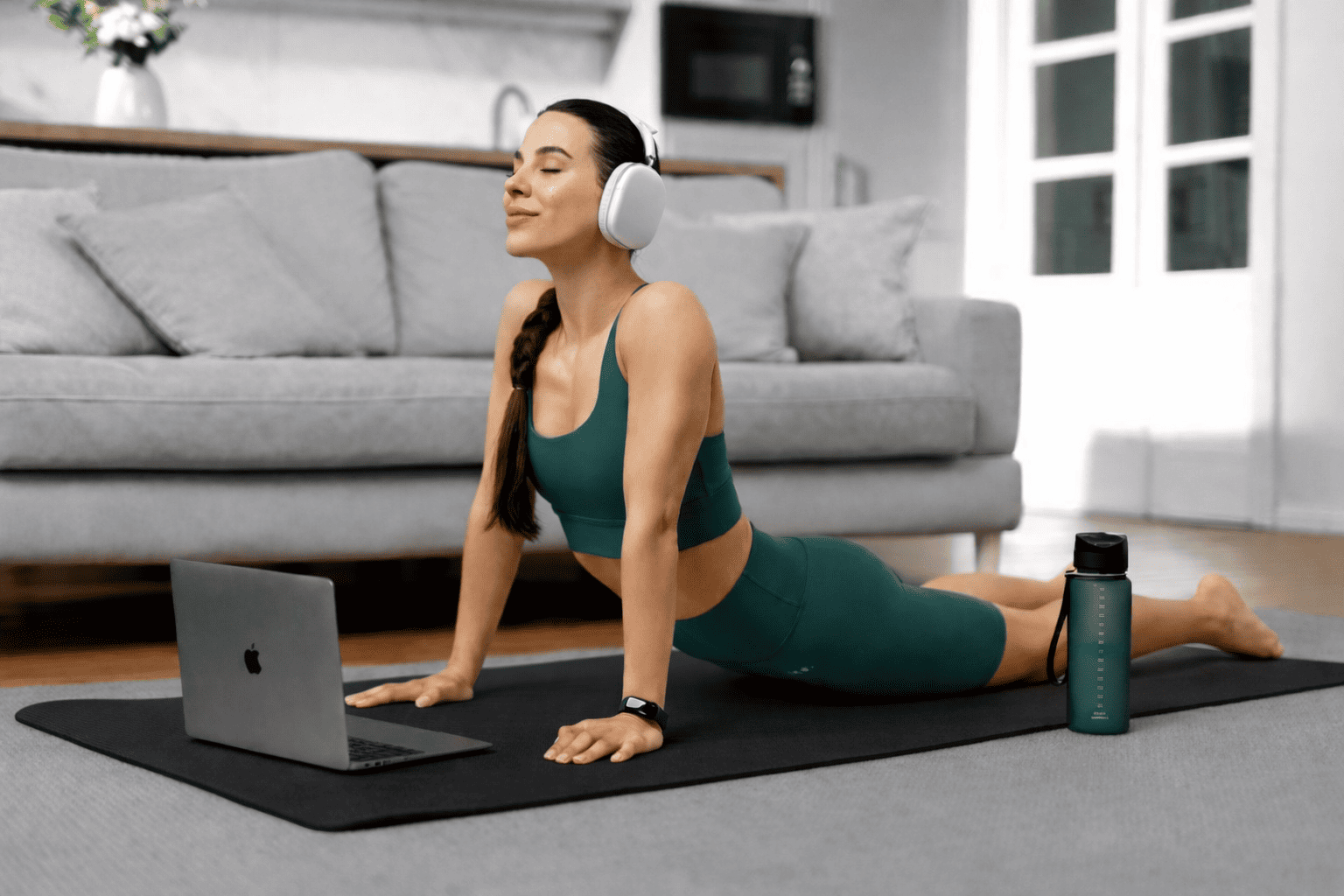
Workout 4: The “Stiff Back, Tight Hips” Mobility + Core Reset
Best for: people who wake up feeling like they slept in a folded position
Time: 12–18 minutes
Equipment: none (optional pillow or yoga mat)
This is the workout for mornings when your body feels older than your calendar says it should. It’s also an excellent option if you sit a lot, travel, or feel back stiffness that improves with gentle movement.
This isn’t a “stretch harder” routine. It’s a “move better” routine.
Flow (2 rounds)
Move slowly. Breathe. Nothing should feel sharp.
- Cat-Cow — 6 slow cycles
- Thread-the-Needle — 3 breaths per side
- Hip Hinge Practice — 8 reps (hands on hips, push hips back)
- Low Lunge — 4 breaths per side
- Glute Bridge — 12 reps
- Side Plank (knees down if needed) — 20 seconds per side
- Child’s Pose — 5 breaths
- Standing Forward Hinge — 5 gentle reps (soft knees)
Finish with a short walk around your home for one minute—just enough to bring the new range of motion into an upright body.
Why it works: Many people wake up braced. This sequence reduces guarding and wakes up the muscles that protect your spine (glutes, deep core, upper back) without exhausting you.
Workout 5: The “Morning Minimalist” 10-Minute EMOM
Best for: people who want structure and speed
Time: 10 minutes
Equipment: bodyweight or light dumbbells
EMOM means “Every Minute On the Minute.” It sounds intense. It doesn’t have to be. In fact, EMOMs can be one of the gentlest ways to add structure because the clock tells you when to stop.
Set a timer for 10 minutes.
Alternate these two minutes for five rounds:
- Minute 1: 8 squats + 6 push-ups (incline is fine)
- Minute 2: 10 glute bridges + 20-second plank
You start the work at the top of each minute. Rest for the remainder of the minute. If you finish in 30 seconds, you get 30 seconds of rest. If you finish in 45 seconds, you get 15 seconds of rest. Adjust reps so you always get at least 15 seconds of breathing time.
Upgrade options (still morning-friendly):
- hold a dumbbell for goblet squats
- add a suitcase carry instead of the plank
- switch push-ups to dumbbell floor presses if wrists hate mornings
Why it works: It’s short, repeatable, and surprisingly effective. It gives you a complete mini-workout without requiring motivation to last longer than 10 minutes—which, in the morning, is often the most realistic ask.
How to choose the right morning workout (so you don’t overthink it)
Here’s a simple decision tree:
- You feel stiff and fragile: Workout 4 (Mobility + Core Reset)
- You feel tired but want a win: Workout 1 (12-Minute Circuit)
- You want strength and structure: Workout 2 (Strength Session)
- You want low-impact cardio: Workout 3 (15-Minute Cardio)
- You have 10 minutes and want zero decisions: Workout 5 (EMOM)
Your best morning workout is the one that matches your nervous system today and still moves you toward your goal over weeks.
Why morning workouts often feel harder—and how to make them feel better
Morning training can feel heavier for reasons that have nothing to do with your character.
Your body temperature is lower. Your joints feel stiffer. Your hydration may be low. If you didn’t sleep well, your perceived exertion climbs. Even your coordination can feel slightly off in the first minutes.
You can reduce the friction with a few small habits:
Make the first 3 minutes embarrassingly easy
A gentle warm-up is not wasted time. It’s a way of paying the morning tax up front so you don’t pay it with discomfort later.
Use light, predictable fuel if needed
You don’t need a full meal before a short session, but if you consistently feel weak or nauseated, try a small, easy option: half a banana, a few sips of a protein shake, a piece of toast. The goal is “enough,” not “heavy.”
Don’t chase failure early in the day
In the evening, you can afford to empty the tank. In the morning, you still need to drive the car. If you love training hard, you can still do it—just not every morning, and not without a proper ramp.
Build a “minimum viable workout”
This is a surprisingly powerful concept. If you tell yourself, “I only have to do 10 minutes,” you’ll often do more. But even if you don’t, you still protected the habit. Consistency is not a personality trait. It’s a system.
A simple weekly morning plan (that doesn’t require a new identity)
If you want to rotate these in a realistic week:
- Monday: Workout 2 (Strength)
- Tuesday: Workout 3 (Low-Impact Cardio)
- Wednesday: Workout 1 (12-Minute Circuit)
- Thursday: Workout 4 (Mobility + Core Reset)
- Friday: Workout 2 (Strength) or Workout 5 (EMOM)
- Weekend: Long walk, hike, or something that feels like life
This plan has variety without chaos, effort without punishment.
The quiet point of a morning workout
A good morning workout does something subtle: it changes how you inhabit your day. It makes you feel slightly more awake in your body, slightly less trapped in your mind. The effect is not only physical. It’s psychological. You begin the day having already kept a promise to yourself.
That is a powerful thing to do before the world starts making demands.
You don’t have to romanticize it. You don’t have to become “a morning person.” You don’t have to post about it. You just have to choose a workout that respects the fact that you are human—especially at 6:30 a.m.
Because the best morning training doesn’t punish you for having a morning.
It helps you have a better one.












 Sign In